
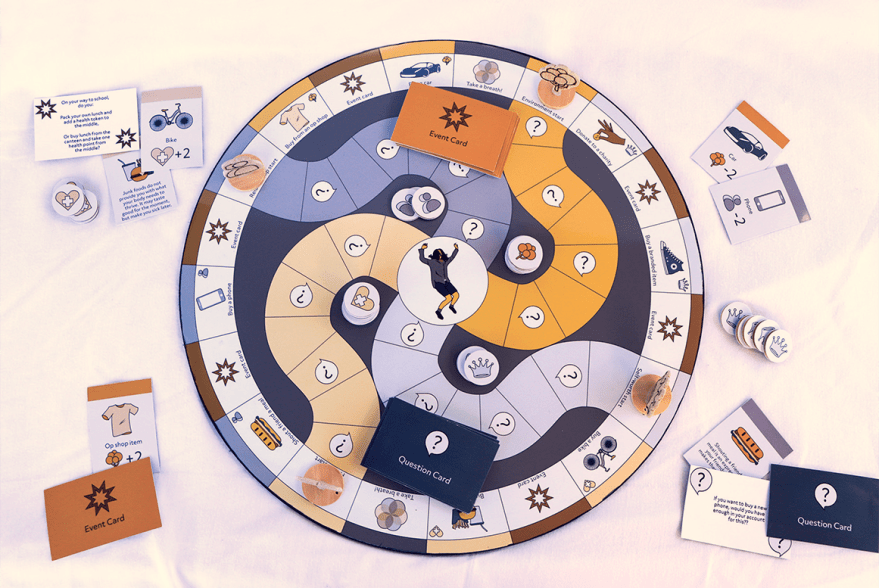
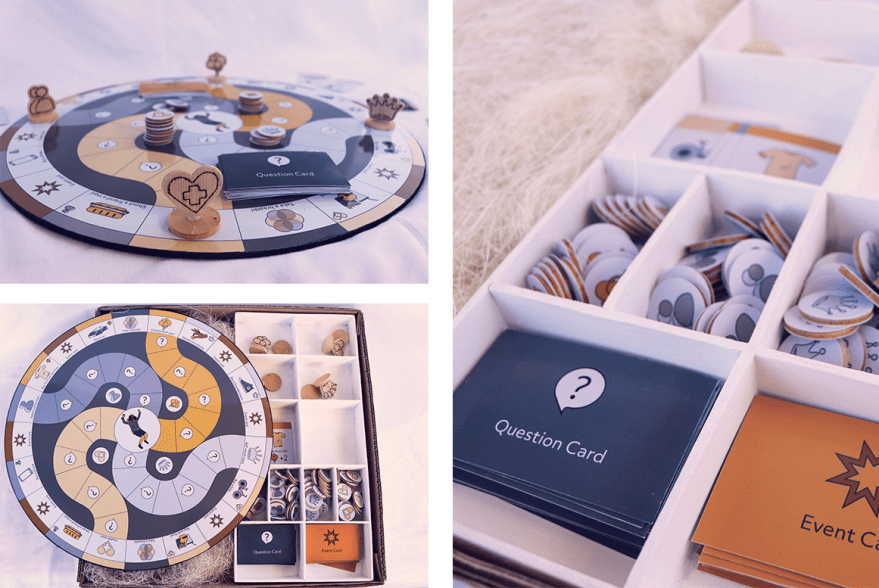
Consumption is an educational board game aimed at tweens to provide them with the skills to make smart choices about their finances and spending habits and how those behaviours affect other aspects of their lives. While I made the end physical design, its creation was a collaborative effort between myself, Rache Andrews, Sindu Karamchedu and Jessica Patricia. We designed the game in response to a 2019 Creative Conscience brief using intervention strategy and road mapping for transition by design. Part of our research findings were gathered through surveying consumers about their behaviours, concentrating on newer technologies more likely to be used in the future such as Afterpay, etc. Our findings concluded that only half of consumers surveyed were able to connect their conspicuous consumption with unsustainable waste practices, and the effects of their behaviour on their relationships and other aspects of life.
We modelled Consumption on Elizabeth Maggie’s “The Land Lord’s Game”, which was intended as an educational tool for children to expose then to the injustices of ‘land grabbing’. This game was unsuccessful in its time (1903), and the patent sold. The game was rebranded and sold as Monopoly, which celebrates exactly the opposite values of those intended by Maggie This resulted in a game with an underlying notion of capitalism and colonialism with players trying to figure out the most efficient way to exploit the resources available. Consumption aims to decolonise the values of competition, individual wealth and exclusivity, and use gamification as a means to educate and facilitate discussion and reflection upon the over reacting effects of our economic choices in areas of life such as health, relationships, and self-worth.
 Tahnee Danielle Design